
Monday
The Hind End
Recently, a student asked me about endings. As she pondered what belongs in a contemporary ending, how they are different from older stories etc, I realized that the question rang familiar because it has been asked of me several times over the past few months. Each time I came up with some sort of response boiling down to how contemporary endings aren't as predictable, aren't as "tada."
But then I thought, you ought to see what other authors think about this; you ought to explore this a bit. What is it about the modern ending? The beginnings often start in medias res, and as one student stated, they often seem to end in the middle of things too. Where does an ending end? How does a writer know when to stop?
During the recently held first online Los Angeles Review workshop, I made a general nuisance of myself by pestering the staff and contributors with all sorts of questions including What elements are in the modern short-story ending? I was especially curious about the endings of less contemporary prose vs. today's story.
Nancy Boutin, the Prose Editor of LAR responded, "Fifteen years ago, my first writing teacher said, 'Write 100 short stories you intend to throw away.' I told him I didn't like short stories, I didn't read short stories, and the endings left me cold. I felt a little better when an uber-literary friend of mine told me he thought New Yorker pieces, presumably the best work circulating, read like really good short stories with the last two paragraphs amputated."
Rust Hills, in Writing and the Short Story in Particular, notes this also: "A lot of modern short stories don't seem to have much of an end at all, really, not in terms of old-fashioned plotting--and this is a great subject of complaint by careless readers."
But, is it that we are careless readers? I venture to say "nah" for the most part. But, we do need to be careful readers to see the slight nuances, the brilliant yet quiet unfoldings.
Jerome Stern, in Making Shapely Fiction, compares past and present fiction brilliantly:
"In some older fiction the ending was characterized by rewards, punishments, and exciting revelations. In contemporary fiction the tendency is to avoid surprises and symmetry and to recognize the story must tell itself all the way through."
Jerome Stern is also the one who says, "Endings in short stories are often muted." I love that term as it hits what I've been trying to say for months. Muted.
He clarifies and warns: "Anything revelatory or portentous at the end of the story is very heavy indeed." We don't want to have pompous endings, oh no. As he says, an ending has to "land safely."
Safely-landed endings. What do those look like? Sounds comfy, like we're wearing our life-vests, but our drinks haven't been spilled.
Rust Hills says, "Whatever 'resolution' occurs at the end is not so likely these days to be brought about by some final development of plotting as it is by the introduction of some thematic note: a new image or symbol (of, say, hopefulness or despair), or by a bit of dialogue or description indicative of a new attitude."
A modern ending, if subdued, then, is more about imagery than explanation???
About the Author
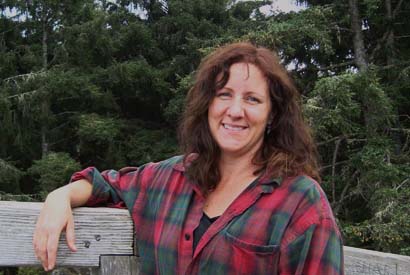 Stefanie Freele's short story collection, Feeding Strays (Lost Horse Press) was a recent finalist for the Foreword Magazine Book of the Year Award and finalist for the John Gardner Fiction Award. She is the Fiction Editor of the Los Angeles Review, a previous editor with SmokeLong Quarterly and has an MFA from the Northwest Institute of Literary Arts. Her recent fiction can be found in magazines such as Glimmer Train, American Literary Review, Monkeybicycle, Necessary Fiction, Corium, and Night Train. Stefanie is the current Healdsburg Literary Laureate. Stefanie will be the judge for the 2011 Press 53 Short-Short story contest. She can be found on the web here.
For further reading, check out FlashFiction.Net's suggested readings of flash fiction and prose poetry collections, anthologies, and craft books, by clicking here.

From Michelle
October 18, 2010 at 12:19 pm
I have always thought that endings in short short fiction should be ones of “soft resignation.” And I call it that for lack of anything better.
Great post!
From LYN
October 18, 2010 at 4:15 pm
Chekhov believed in “returning his characters to life” as the endings of his short stories–that, in fact, as in life, often there is no resolution…
From gaydegani
October 18, 2010 at 9:15 pm
I like endings appropriate to what’s gone before, but I still want to feel the ending carries with a little something. However, I don’t want the author to tell me. I just want to know it feels right. Elegant, maybe the right word??? Not sure. Anyway love this topic because it’s actually kind unknowable.
From Nancy Stebbins
October 19, 2010 at 2:28 pm
Wonderful post, Stefanie. I’m going to read it again, and then I’m going to go find Jerome Stern’s book.