
Tuesday
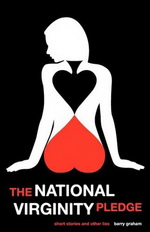
The National Virginity Pledge (short stories and other lies)
Barry Graham
Another Sky Press, 2009
Barry Graham's The National Virginity Pledge (short stories and other lies), gives its readers twenty-one stories (cleverly picked for the card game 21) that run away from expectations. And what the characters do is run away, away from relationships and responsibilities and morality and even sex and yet remain endearing nevertheless because of their complexities. Almost all the stories are infused with sexuality, gambling, smoking, drinking, and food.
"On The Edge," the first story, sets the mood for the rest of the chapbook.
I can't remember if it was before or after I pissed off the side of the Grand Canyon, but there was a man standing along the road holding a camera and the car in front of me swerved to avoid hitting a squirrel and ran over the man taking pictures of the sun setting behind the canyon. I did nothing until I got to Las Vegas where I stopped at a Del Taco for a spicy chicken burrito, then at the car wash to scrub the dried blood off the side of my car.
What this, and the other twenty stories deal with is a "the lack of concern"; this idea hovers around the entire chapbook. The characters hate people who show apathy for others, and yet they each struggle with it themselves. This contradiction keeps the reader interested, because the characters expect so much from each other while at the same time being unable to give as much back in return. And what I love about these stories is that the author seems unconcerned with critics. It seems as if Graham writes what he wants to write and not what others want him to.
In another story, "This Story Is Not About Ham and Cheese Sandwiches," the male character walks away from the opportunity to have sex with a woman who randomly shows up in his house with wet pants and "bruises." Wonderfully, the title informs the reader that the story will have a twist and won't be about what it seems to be about in the first paragraph--food and Ms-Pacman. And what it ends up being about is sex, or rather the lack of it.
"Your pants are dry."
"You'll have to put them on me."
I threw them at the back of her head and walked in the bedroom, closed the door, pulled her panties out of the dresser drawer, and held them until I heard the door close and the screen door bang back and forth against the white chair on the front porch.
What stands out in this story is the male character's unwillingness to act (or think) as the female character wants him to or expects him to. This is also something that can also be noticed in "To The Short Thick Student With Big Tits And Auburn Hair That Sits Two Rows In Front Of My Desk In My 11:00 AM History Class," which comes in the form of a letter to a classmate to inform her that he wasn't actually staring at her "tits" but at her feet. The roles of confusion are repeated throughout the chapbook, and at numerous times it is the female character acting unexpected rather than the male character. "All His Chips (a love story)" illustrates this with a female character who never does what she claims she wants, to the distress of the male character.
I was intrigued by the way the stories flow into each other, since on most occasions the last sentence of one story repeats an idea or word in the next story. The second story, "Cats and Dogs; Like Rain" ends with talk about war while the third story begins with a Vietnam War veteran. "All His Chips (a love story)" ends with the narrator trapped in a closet, and then my favorite story, "Parable Of the Dead Rolling Snowball" begins with the narrator as a child trapped outside in the cold; "Late October" starts with the word dead in the first sentence as dead is in the last sentence of the previously mentioned story.
But what really makes this a great read are each of the character's desires, obsessions, fears, and flaws: the desire for companionship and answers, the obsession with money and drugs and even feet, and the fear of loneliness and responsibility.
The National Virginity Pledge is equal parts laughter and sadness. The honesty of each story will compel you to read on and remember.
Read the interview with Barry Graham here.
About the Author
![Photo[1].jpg](http://flashfiction.net/wp-content/uploads/2011/01/Photo5B15D-1.jpg) Benjamin Grossman, an MFA in Creative Writing candidate at Rosemont College, writes screenplays and novels, as well as poetry and flash
Benjamin Grossman, an MFA in Creative Writing candidate at Rosemont College, writes screenplays and novels, as well as poetry and flash
fiction. He experiments with mixing different writing genres, but prefers fiction. In his free time, Benjamin enjoys listening to music, reading
history, running, and watching sports.

For further reading, check out FlashFiction.Net's suggested readings of flash fiction and prose poetry collections, anthologies, and craft books, by clicking here.

