
Monday
Thank you for accepting my invitation for an interview.
No problem. I'm happy to do it.
I consider myself a poet. Flash fiction appeals to me for many of the same reasons poetry does: brevity, concision and the need to make every word count. What draws you to flash fiction? When did you first encounter flash fiction?
When I was a teenager I used to read science fiction. One day I found William Golding's Free Fall in the science fiction section of a secondhand bookshop. I loved it. It was the first book I read that actually delves into the human condition. I immediately tried to write a novel, failed miserably and didn't finish it. After Golding I discovered Kafka, Plath, Nin, Kavan and others. I found that my reading tended towards the surreal and the absurd. I then did some acting, and wrote a couple of plays, which have been lost. At university I wrote a number of stories and poems. The poems were garbage and all have been lost. The stories I wrote were very short. At this time (2000) I'd never heard of flash fiction. So I didn't choose flash fiction, it chose me. I have a very short attention span. So writing short fiction suits me.
What did you study at University?
I didn't go to university till I was 25. By that time I had done a variety of jobs, lived in Spain for a couple of years, and worked in theatre. I wanted to study acting but I was considered too old. So I did Spanish, thinking I could teach, and discovered that learning a foreign language was very beneficial to me as a writer. Firstly, because the writers we studied were living writers and I found it exciting to study the writing of authors like Esther Tusquets and Linda Berron. And secondly, when I saw how a foreign language is constructed and used by creative writers it opened a whole new vista of how words can be manipulated. My first stories were written at university and inspired by Lourdes Ortiz and others.
You mention influences above. Do you find techniques or modes of writing in the work of those who have influenced you that tends to appear in your own writing? Do you ever try to imitate your favorites? Do you think imitation helps a writer become better?
I think it's very difficult to assess what influences you as a writer. Just because you enjoy a writer doesn't necessarily mean that writer will influence your work. Raymond Queneau is not one of my favorite writers. I find him too cold and intellectual. But I'm certain he has influenced me. I love writers who break rules, experiment and try out new things, and Queneau does exactly that. I love the way he looks at the nature of writing and develops new forms of narration. I think his Exercises in Style is a must read for all aspiring writers. On the other hand Gioconda Belli is possibly my favorite writer, but I can't think of anything of hers which has influenced me. Thematically she usually follows the tradition of magic realism, but her writing style is too classically perfect and subtle for me. German romanticism and surrealism are other influences. I would never consciously imitate a writer. A writer needs to develop her own style. The important thing is to find your own voice. I'm still looking for mine.
A lot of your writing is funny (Kate Moss getting plastic surgery to add an extra leg, for instance). For me, writing funny is very hard. Do you find it difficult or does it come naturally? What are you trying to accomplish with your work? Why write?
Some stories come out as comedies. It's not something I specifically try to do. I enjoy writing, and I hope people will enjoy reading what I write. I'm not trying to accomplish anything beyond that.
In this and some of your other answers I hear you saying that you write for your own pleasure (which I totally understand that). From this answer I hear you saying that you publish these pieces simply to entertain. Is that what you're saying?
I think we all need to find our own strengths as writers. If you write beyond your strength what you produce is very weak because it has overburdened you. I would love to write something that changes society for the better. Much in the way that Upton Sinclair's novel The Jungle changed laws regarding the meat packing industry in 1920s America, or Cathy Come Home, a sixties TV play by Jeremy Sandford, changed the law in the UK for housing homeless families. But both were ultra realistic, almost documentary in style, and each required months of research. Very different from how I write. I don't mean I don't like reality, but I prefer stories to be an escape from reality. The idea of watching people suffer in order to be able to write about it doesn't appeal to me at all. Having said that, not all my stories are comedy; some have serious themes, like "After The War" or "My Vegetable Love."Both of which are about war but in very different styles.
You had many pieces published last year. When did you first start writing? When did you first get published? Talk a little bit about your submission process and the process of publicizing yourself. Do you concern yourself with managing and maintaining your fan base and publicizing yourself?
After University I did some teaching, travelled a bit, fell in love, got married, had a daughter, and didn't do much writing. In 2010 I started writing stories again. I discovered online publishing. So I submitted some stories to online magazines. I tend to just send submissions to any magazine, without thinking too much about it. After I'd had a few stories published, I saw that a lot of writers have blogs. So I tried to start one but I'm not very good with computers and it didn't really work. A friend told me about Weebly, so now I have a Weebly and put all my published stories there. Beyond that I don't do any publicity.
Do you have long-term goals for your writing? Do you intend a career in writing, be that teaching, editing, or any other writing related field?
There can be few careers more precarious than professional writing. My part-time day job, which I love, helps pay the rent and buy food. I don't think I'd like being a professional writer. I'd become too self-absorbed and end up writing about a writer writing. Oh, I do that already. The main problem for me in writing for a living would be the pressure put on me by an agent or publisher to write what they see as commercial, rather than allowing me to write what I want to write. Very few of my favorite writers earn (or earned) a living from writing alone. Also I'm a very unsociable person. The idea of a literary dinner and prize giving makes me feel nauseous.
What else do you write besides flash fiction? Do you write poetry or other forms that you do not publish?
Some stories come out long, some come out short. I don't write poetry. 90% of what I write doesn't get finished. And 90% of what I finish isn't any good. It's the writing process I enjoy. Getting them published is just an added bonus, but never the reason for writing. I used to write short plays and two or three that I co-wrote have been performed. I'd like to get back to writing plays but British theatre is stuck in 19th century naturalism and naturalism for me is an anathema to theatre.
In the Kate Moss piece you take the fad of cosmetic surgery to an absurd level. This piece is clearly meant to be entertaining, but are you making a larger point?
SM: In an online thread someone had posted, "this thread has legs like a millipede." So I followed that with, "or legs like Kate Moss." The comparison between Kate and a millipede intrigued me, the aspect of quantity vs. quality that is relevant to so many things in our lives. So I wrote the story. I find that women's fashion keeps emerging in my stories, "Bouffant" about the outlandish hairstyles of the Versailles Court, "Rebellious Shoes" about buying stylish but uncomfortable shoes. I try not to be didactic in my writing. I think the ambiguity in a story should be such that different people can read different things into what you write.
I really liked the piece "Fire in the Heart." I like the way the piece is a wistful dream and then you yank the reader out of the dream with a red, bloody mass of a body on the street. Can you talk about this piece? What brought this piece on?
"Fire in the Heart" is an old story. In the window of a secondhand bookshop, I saw a book with a garish cover of a woman jumping from a burning building. I always carry a notebook and pen. I wrote the skeleton of the story in the street, but I didn't have an ending. The ending came about eight years later after I found the unfinished story when I was clearing out some papers. I think it's essential for humans to dream and I often juxtapose dream and reality in stories. That doesn't mean that the dreams are always wonderful and reality is a nightmare. Though in this story they are.
What are you writing at the moment?
I'm usually writing six or seven stories at the same time, in various states of completion. I started a story about the Olympic Games featuring a woman who has lost her home to the building of a stadium and has been moved to a complex, which has unbearable amounts of noise and construction dust. It's doubtful if this story will get finished. Another I'm writing uses a different type of narration, something a bit like a children's TV documentary commentary, "Now, if we go to the house, we should find them…." The Olympic story won't get finished because it is written in a very traditional narrative structure and I'm already bored with writing it. Whereas the second story is more interesting to me because I'm unsure where it's going, or even how to write it.
Please give a brief bio if you wish.
While I agree that a writer's life affects what they write, for me the important thing is the story. Whether it was written in prison, or while the writer was half way up a mountain, shouldn't affect the reading pleasure.
FF.Net Author's Note
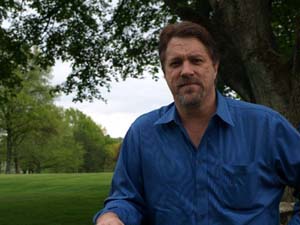 Thomas Jay Rush is the owner of a small internet-based software company, a fact he chooses to ignore, focusing instead on writing short fiction, creative non-fiction, and poetry. Jay lives with his family in Gladwyne, Pennsylvania.
