
Thursday
 Elaine Magarrell, teacher, artist, and writer, is the author of two books of poetry: On Hogback Mountain (1985, winner of the Washington Writers’ Publishing House Prize), and Blameless Lives (1991, winner of the Word Works Prize). A selection of her poems appeared, most recently, along with poems by Cicely Angleton and Reed Whittemore in Inventory (2008, Barclay Bryan Press.) Her poems have appeared in numerous literary journals. Born in Iowa, she is a long-time resident of Washington, DC.
Φ
What first attracted you to very short fiction?
I came across a contest offering a prize for short, short fiction, and became intrigued with the idea.
I recently reviewed your flash piece titled “Chickens,” featured in Micro Fiction. In this piece I was fascinated by how you were able to write about a commonly known fact of chickens being used as food, but describe it in such a way that was entirely new and emotional for the reader. How do you enter into writing about topics such as food in a way that is inventive and meaningful in a different way? Do you conduct research based on interest or come up with ideas on your own and explore them in your writing?
This is hard to answer. The origins of a poem are mysterious. I don’t generally do research before beginning a poem, although ideas will sometimes grow out of things I’ve read. I don’t recall what brought me to the subject of chickens for this piece.
We often think of the farmer as a symbol of life, providing the freshest goods and being close to the earth. Here, he is a murderer. Where do you find inspiration for characters like this?
Out of reality. From the beginning of human history, men have murdered. Cain, a farmer, murdered Abel, who raised animals. All the meat we eat comes from the killing of animals.
I also found out that you are a poet. Are you able to use certain things you’ve learned from flash in poetry, and what do you find are the major overlaps?
For me, poetry is primary and fiction secondary. Obviously there are line breaks in poetry and not in flash fiction, but I’ve never cared much about line breaks anyway. “Chickens” was republished, with line breaks, in my poetry collection, Blameless Lives.
Do you have any advice for poets looking to write longer work such as flash?
Not really. Some poems (though not, generally, mine) can be longer than works of flash fiction. It’s a matter of choice and feeling, intuition.
Do you think there is a difference between flash or prose poetry? Does the difference matter?
One obvious difference is that flash involves a narrative element and much prose poetry does not. Many poems are also narratives, however. The difference doesn’t matter much to me.
What are you working on now?
I’m not writing now.
I saw that you have worked as a resident writer in the D.C. district schools. Do you have any advice for younger writers aspiring to teach writing?
Yes. They should allow their students great freedom. Nothing the student does is wrong.
Φ
About the Author
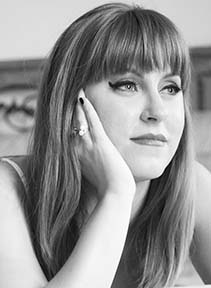 Kara Cochran is in her first year of the MFA program at Rosemont College. In 2011, she received her BA in Creative Writing and German Studies from Denison University in Ohio. After graduation, she worked for a nonprofit organization and attended law school for a year before coming to her senses and applying to Rosemont. At Rosemont, she is the poetry editor for the Rathalla Review and writes poetry, flash fiction and novel-length work. Kara’s work tends to be influenced by her upbringing in a Foreign Service family, and although she spent much of her childhood overseas and in various parts of the US, she has lived in Philadelphia for two years and is proud to call it home. In her free time, she likes to read, run, drink wine, go to the movies with her husband and hang out with her orange cat, Clementine.
