
Monday
[Editor's Note: Curtis Smith authored this article as part of FlashFiction.Net's Monday Guest Blogger series. The article begins with a picture and quote from Richard Ford; Curtis Smith's picture and bio can be found at the article's end. This essay originally appeared on the Press 53 website.]
 "I don't really know if life, as lived, changes in obvious epical ways. I think that literature, as a convenience, tries to assert that it does. You know the last line of Frank O'Connor's wonderful story "Guests of the Nation"? 'And anything that happened to me after I never felt the same about again.' Literature says that; that things occur after which we are different. I think, in our lives, those forces are much more glacial in effect. They're slow and they're big and we don't know until years later that those things have happened. Of course if your parents are wiped out in an automobile accident--if our mother shows up with another man, we know something's happening. But for the most part, human beings are trying to make their lives seem normal, not epical. They're trying to make their lives seem not ragged, not insurmountable. And so those moments get cloaked." ~ Richard Ford
The issue of misunderstanding and then trying to make sense of what is misunderstood may well be the dominant theme of modern literary fiction. Lucky us, to live in such an age, to take for granted the good fortune of having our needs so amply provided. Free from the dreary and exhausting and often icky tasks necessary for survival, released from worries of crop-swarming locusts and man-eating bears, our bellies sated and then some, we turn our attention inward.
Consider the wonders man creates with this inward focus. He has altered the courses of white-capped rivers and harnessed the atom's power. He has navigated the oceans and the heavens. And what separates the artist's inward focus from the engineer's? The architect's? The explorer's and the scientist's? These creators are afforded the luxury of the correct answer. Their structures stand. Their vessels return. Their equations balance. They construct keys, and if their craftsmanship is true, their calculations correct, they slide their keys into locks of misunderstanding and are rewarded with an opening click.
But what of the artist's inward focus, his attempts to address misunderstanding, to define the epical and glacial forces of his life and then assign them some vague, untestable element of shape? Somewhat grandiose, our efforts when one considers the enormity and elusiveness of "understanding." We'll never reach our goal, each word we write a step in a marathon that offers no finish line. Yet we keep writing, keep running, arming ourselves with makeshift keys along the way, hoping to spring the next lock, hoping to understand just a little bit more. . .
* * *
"Books don't happen in my mind; they happen in my stomach." ~ Isabel Allende
Here are our tools--our eyes and ears, our minds and hearts and souls, the stockpile of experiences that comprise our pasts. Here is our fuel--our desires, our longings for acceptance and understanding (!) and recognition. Beyond whispers of DNA combinations, we are essentially no different than our fellow human beings, the folks we curse under our breath as we languish in lines at the post office and supermarket--yet there is one steadfast and telling exception. The days' bombarding influx of images and sounds are filtered through our sensibilities, and for one reason or another, we become struck by one or more of them. It could be the bored way our checkout girl chews her gum; perhaps it will be the distracted tapping of a duct tape-mended boot. Something about the scene will resonate and take root deep in our bellies, refusing to let go. In the darkness under our skin, the image grows, a private beckoning we are compelled to investigate. So we sit down with pen and paper, and using our limited tools and the compass of our emotions, we begin the journey of understanding.
* * *
So much of what we do in those hours when we're actually making sentences, inventing characters and feeling our way through the threads of a plot, is hunch and feel -- half unconscious and somewhat autohypnotic. Those rituals of getting ready to write seem to conduce a kind of trance state. ~ John Barth
Webster defines trance as "a state of partly suspended animation or inability to function; a somnolent state (as of deep hypnosis); a state of profound abstraction and absorption." A trance--of course!--how else to explain the passage of hours spent at our desks, the voices that call out to us alone. How else to explain the temporary blindness that befalls us, the piles of laundry and leaky faucets we fail to address because we've fallen into the artificial worlds we've created. I'm no shaman, no Jim Morrison or Merry Prankster, but, yes, I understand the lure and power of trances.
* * *
"Which is what being an artist is. It's to have access to your own unconsciousness but also to direct it." ~ Allan Gurganus<
And what do we do with our trances, an eggshell-delicate state of mind, which we cup and protect against the ever-intruding forces of our lives? A trance without focus or direction is useless, so we nudge it, wrestle with it, poke and prod it. The words and sentences and images we seek are slippery at best, and on many days, they steam into a maddening gas that passes repeatedly through our grasping fingers. Yet even our most maddening sessions are saved if we can rise from our desk with a clearer image, with a single sentence fought over and finally pinned down. Halleluiah and amen, says the exhausted shaman emerging from his trance.
* * *
"Whatever our theme in writing, it is old and tired. Whatever our place, it has been visited by the stranger, it will never be new again. It is only the vision that can be new, but that is enough." ~ Eudora Welty
So we keep our eyes and hearts open, and in heads, we ask questions, and if we're fortunate enough to have one answered, we ask another. And another. And another . . .
* * *
Mostly, we as authors repeat ourselves -- that's the truth. We have lived two or three great, moving experiences in our lives -- experiences so great and moving that it doesn't seem at the time that anyone else has been caught up and pounded and dazzled and astonished and beaten and broken and rescued and illuminated and rewarded and humbled in just that way before.:" ~ F. Scott Fitzgerald
I pass our local hospital every day on my way to work, a sprawling structure that stands back a few hundred yards from the street, far enough to lose its shape in Pennsylvania's October morning fogs or February's blinding snows. Inside is the maternity wing where my son was born, the emergency room where I've vomited and bled, the reception area where I cried and hugged my wife after her head-on with an eighteen-wheeler that totaled our car but which she miraculously survived.
As I drive by, I am often humbled by all the stories being told inside, the lives changing for better and worse, the newborns' bawling welcomes, the cancer ward's sighing last gasps. The moments that have shook and shaped me are unique only in the scope of my own experience--and set against a backdrop only slightly larger, they are downright mundane. So why do we obsess about them? Why do we revisit them, dissect them, examine them through scrims of fictional constraints? Here is where we writers lose our group voice, for each of us has our own answers. Some of us wish to explain, to understand. Some of us enjoy puzzles, the putting together of seemingly disparate pieces to make a compelling whole. Some of us feel offended, angered because we believe we have a right to answers. Some of us simply enjoy the trance, so we slip into its embracing waters whenever the opportunity arises.
* * *
"Everyone of my novels could have been entitled The Unbearable Lightness of Being or The Joke or Laughable Loves; the titles are interchangeable; they reflect the small number of themes that obsess me, define me, and unfortunately, restrict me. Beyond these dreams, I have nothing else to say or to write." ~ Milan Kundera
Get to the point, the exasperated reader sighs, so here it goes. It is important to understand, at least at some just-above-instinctual level, the forces that have led us to this solitary, often frustrating art form. I believe every breathing person is haunted. Choose your poison--lost love, absent parents, death, regret, unspeakable beauty, or a thousand others. Hauntings reach us in a context much richer than words alone, and in the sheltered nooks of our souls, they blossom into strains of harsh, extremely personal mythologies. Here are the backbones of the stories we are compelled to write over and over again.
For the beginning writer, these internal giants serve as roadblocks to the deeper places we long to reach. We write around them, sometimes avoiding them, sometimes attempting to address them, as if our initial words may suddenly force them into clarity. The more experienced writer, having penned countless drafts of stories and novels that have fizzled and died for want of substance and personal truth, has learned to embrace indefinable obsessions and to recognize them for the melancholy yet wonderful gifts they are.
* * *
"The most demanding part of living a lifetime as an artist is the strict discipline of forcing oneself to work steadfastly along the nerve of one's own intimate sensitivity."
~ Anne Truitt, sculptor
So what is left for us but to continue the odd duality our craft demands, the burrowing inward to understand our motivations and demons, while at the same time keeping our eyes forever vigilant in the search for clues, our ears straining to hear the music that surely plays beneath the whirl and din of our days. And while we are haunted, we are also truly blessed for a part of us will forever rejoice at seeing our surroundings in new ways. Wonderful, the slant of morning sun that cuts so stunningly between downtown's skyscrapers; wonderful, the smell of a pine forest after a spring rain; wonderful, the cold-sunshine glimmer of January's roof-clinging icicles and the tiny, wandering footprints a child leaves in the snow.
We have our trances and our words, our heart and our eyes and our questions that remain unanswered. What more could we want from this life we've chosen?
About the Author
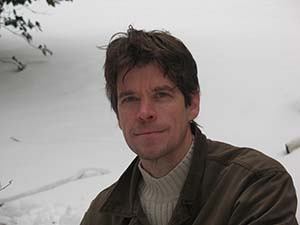 Curtis Smith is the author of two novels (Sound and Noise and An Unadorned Life), a story collection (The Species Crown), and two collections of short-short stories (In the Jukebox Light and Placing Ourselves Among the Living). The coming year will see the release of his next story collection (Bad Monkey, Press 53), novel (Truth--or something like it, Casperian Books), and his first essay collection (The Agnostic's Prayer, Sunnyoutside Press). His stories and essays have appeared in over fifty literary journals and have been cited by The Best American Short Stories, The Best American Mystery Stories, and The Best American Spiritual Writing.
