
Thursday
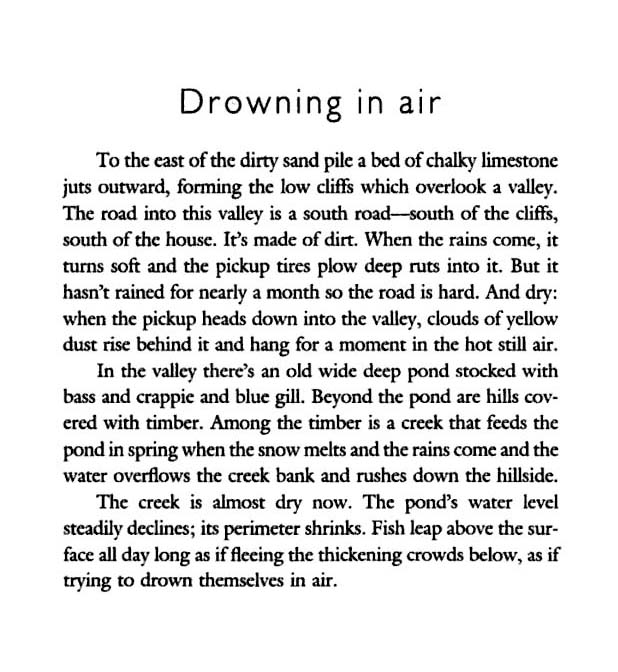
The back cover of Debra Di Blasi's Drought describes this book-in-flashes as "Postmodern American Gothic." The cover continues, "Di Blasi dissects a young couple's relationship on a failing cattle ranch, allowing us to see all the subcutaneous mental and physical violence they endure. As unceasing heat kills the couple's livestock, Di Blasi focuses a science writer's exactitude and a poet's charged restraint on the human cost of rural tragedy." It's a must-read surely for anyone who loves compressed fictions. Here's an excerpt (with the permission of the author) that appears early in the book:
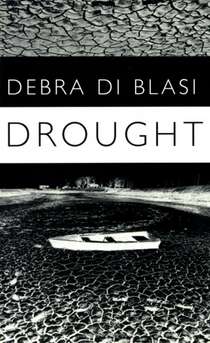
It is a book of perfect circles and cyles, and that "tragedy" alluded to in the back cover is a charged, tricky word, because tragedy remains one of those undefined terms, as mysterious as the gods and goddesses, genetics and will, fate and destiny, the cycles of rain and drought. I've written elsewhere about tragedy (here, here, here, and here). I'm particularly drawn to tragic theoretician and critic Normand Berlin's The Secret Cause and its insight into American tragedy, "connected with a journey of escape, of going away from...restrictions...from the evil and brutality of the world, only to meet and be wounded by it" (153).
Willa and Kale perhaps came to Drought to escape the restrictions and brutality of the world left behind, and like many American tragic characters, find the very thing they hoped to elude. The world in Drought for Willa and Kale is hard and dry. There are other cycles and seasons and times alluded to in the excerpt above: "when the rains come" and "spring when the snow melts." But now, as the water level steadily declines and the perimeter shrinks, there is only this sense of fleeing, like the fish, all day long.
What I love about Di Blasi's Drought is that sense of compression, not only in the language, but in the place itself. There's something elemental and ancient about the language: sand, chalk, cliffs, valley, dirt, rain, dry, clouds, pond, hills, creek, snow, hillside, and that final "drown themselves in air." The specificity of place leads the reader to the universal; to me, that's the challenge of compression. Look at the simple loveliness here of the adjectives: "dirty, sand, chalky, low, south, soft, pickup, deep, hard, yellow, hot, still, old, wide, creek, water, thickening." Notice how the word thickening stands out, not only here, but in those final words, the way thickening has its own weight and substance, how it is part of the drowning and apart from it.
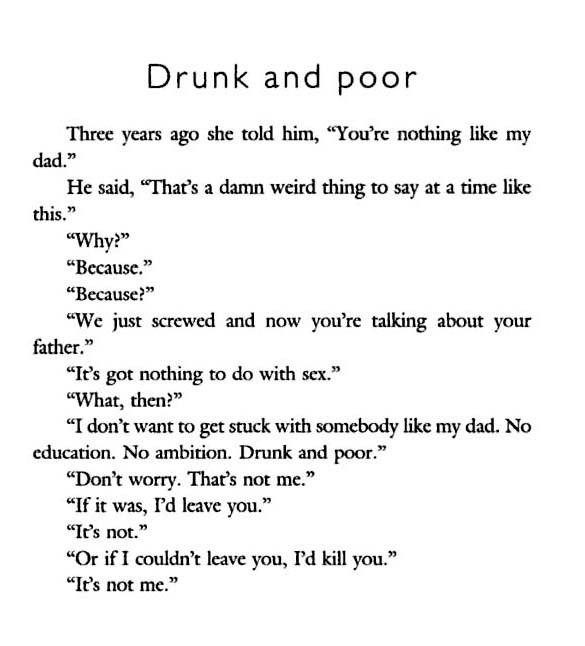
How many times have I avoided the "dialogue" story? How many times have I told other writers how such dialogue-based pieces don't work? Countless times. And look at this one. It proceeds without attribution. Man and Woman, She Said and He Said, Drunk and Poor, back and forth, rain and drought. It is desire, I'm often told, that drives narratives into existence, and here is Willa's: "I don't want to get stuck..." And there she is now, stuck. (That irony, for me, is what drives tragedies into existence).
"Not me," Kale says, three times, three the magic number of bare-bones tales, as if invoking the fairy forces to undo a curse. Three years ago. No education, no ambition, drunk&poor. Against Kale's "that's not me" are Willa's three words: "I'd leave you," and, if not that, "I'd kill you." Tragedy is about that desire to escape that leads to further imprisonment, the wanting of a world without traps only to land in one that cannot be unloosened, the wish for control of one's fate, the craving of and longing for the world as it might be, the need to assert one's will against a world that would have it otherwise.
Such is the Postmodern American Gothic world of Di Blasi's Drought. Postmodern, to me, means a work that's aware of its own creation. American because of its place, its desire for escape. Gothic as fish fleeing the thickening crowds below, as if trying to drown themselves in air.

For further reading, check out FlashFiction.Net's suggested readings of flash fiction and prose poetry collections, anthologies, and craft books, by clicking here.
