
Monday
A few days after FlashFiction.Net published my little piece about The Muted Ending, I received a rejection note from an editor letting me know that "the ending of this story was too muted."
Did the editor read my piece about endings? Was this purely coincidence? Of all words to choose: muted. What I do know is that once again, a comment or something I've read along the way whispered to me Psst—you, Stefanie, you may not know what you're doing.
Did she say my ending was bad? No. Was it bad? Not really. But I did revise the story and now, I love the ending. It isn't too trite, not too clenching, not too gripping, not too revealing.
What about a bad ending, a heavy-handed ending? What does that look like?
In my experience a bad ending tells itself that it is an ending. It does the "tada" by wrapping up tidily, clearing up, or showing off. Not necessary. Or, it has a corny twist. Or a twist that you weren't prepared for. Or, the promise or setup made at the beginning that doesn't come through. Or the ending summarizes as if the reader didn't "get it" (good way to insult readers: treat them like they are reading a seventh grade essay "In conclusion…"). Or, it ends in trite cutesy dialogue. Or, as another magazine editor warns, "Please don't end in another sunset!"
I pestered Dan Coshnear, a contemporary author of short stories. His collection Jobs And Other Preoccupations won the 2000 Willa Cather Prize. He is the author of a terrific Los Angeles Review story that will appear in the Fall 2011 issue. His collection sits on my favorite shelf : a collection of truthful, painful, intelligently humorous, excellent short stories.
"What can make an ending go flat, not work, or bomb out?"
If the author/narrator tries to process the story for the reader—well, that's just deadly. If the climax/resolution is off target, fails to put to rest the inciting question of the story, then that is a disappointment. If the ending was telegraphed pages before the reader got there—that's a bit of a bomb. I think the ending can be like a brilliant distillation of themes that ran through the story, and in a way, it is a poem, but it should be consistent with the language and the tone that precedes it.
Here I say something about what I think a story is. It is a jack-knifing 18 wheel truck. It is the past crashing into the present. It is a culmination of many seemingly disparate parts or threads. The satisfaction that I find often at the end of a story is first a feeling, a feeling that precedes understanding. The parts come together and it is pleasing—even when the result is very sad.
Bruce Holland Rogers, the Nebula Award winning author, and dedicatee of the Spring 2011 Los Angeles Review issue, says regarding this about the bad end:
What can make a love affair go flat, not work, or bomb out? There are so many possible ways to go wrong. Writers are always inventing new ways to mess up the ending of a story. I can report that when I write a bad ending, it's usually because I had the ending in mind when I began the story and wrote the story with that ending in mind. Such endings usually turn out to be seed crystals that got the story going. They did their job of getting me to write the story, but they need to be discarded for something better.
Which is what I did, discarded that bunk end, picked up my occasionally-tiny ego, and wrote something just a hair grander.
About the Author
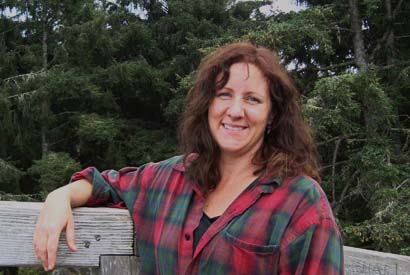 Stefanie Freele is the author of the short story collection Feeding Strays (Lost Horse Press), a finalist in the John Gardner Binghamton University Fiction Award and the Book of the Year Award. She recently won the Glimmer Train Fiction Open. Her published and forthcoming fiction can be found in Glimmer Train, American Literary Review, Night Train, The Florida Review, Whitefish Review, Necessary Fiction, Pank, Word Riot and Corium Magazine. Stefanie is the Fiction Editor of the Los Angeles Review. Stefanie's second collection, Surrounded by Water, will be published by Press 53 in 2012.
For further reading, check out FlashFiction.Net's suggested readings of flash fiction and prose poetry collections, anthologies, and craft books, by clicking here.
